
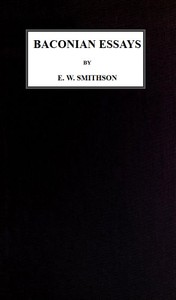
Baconian Essays by active 19th century E. W. Smithson
Let's be clear: this isn't a novel. Baconian Essays is a collection of arguments, a manifesto from a specific moment in history. The author, E.W. Smithson, was a true believer in the 'Baconian theory,' the idea that the brilliant Elizabethan statesman and philosopher Sir Francis Bacon was the true author behind the works attributed to William Shakespeare of Stratford-upon-Avon.
The Story
There's no plot in the traditional sense. Instead, Smithson lays out his case like a lawyer. He questions Shakespeare's modest education and background, arguing that the plays show a depth of knowledge about law, court politics, and classical literature that a glovemaker's son from the provinces simply couldn't have possessed. He points to Bacon's vast learning and his known interest in ciphers and secret writing. Smithson combs through the plays and sonnets, looking for hidden messages and parallels with Bacon's life and philosophy. The 'story' here is the drama of the argument itself—the mounting evidence, the dismissals of rival theories, and the fervent attempt to rewrite one of the biggest stories in English literature.
Why You Should Read It
You won't read this to be convinced that Bacon wrote Hamlet. Most modern scholars dismiss the theory. You read it for the sheer passion of the argument. Smithson isn't a dry academic; he's a partisan, and his writing crackles with that energy. It's a window into a time when this debate was a live wire in intellectual circles. More than that, it makes you think about authorship, genius, and why we're so attached to certain origin stories. Why is it hard for some to believe that a man of relatively common birth could be that brilliant? Smithson's essays, in their flawed certainty, tell us as much about the 19th century's class anxieties and hero worship as they do about the Elizabethan age.
Final Verdict
This book is a niche gem. It's perfect for history buffs who love intellectual rabbit holes, or anyone fascinated by literary controversies and conspiracy theories. If you enjoy seeing how people build a case from the ground up, even a flawed one, you'll find this compelling. It's also great for readers who like primary sources that show historical thinking in action, not just summaries of it. Just don't go in expecting a balanced debate—you're getting one very passionate side of a very old argument, and that's exactly what makes it so interesting.
The copyright for this book has expired, making it public property. It serves as a testament to our shared literary heritage.
Karen White
10 months agoThe peer-reviewed feel of this content gives me great confidence.
James Jackson
9 months agoFrom the very first page, the content flows smoothly from one chapter to the next. I couldn't put it down.
Matthew Robinson
1 year agoTo be perfectly clear, the clarity of the writing makes this accessible. Truly inspiring.
Donald Taylor
4 months agoThis is one of those stories where it manages to explain difficult concepts in plain English. I couldn't put it down.




William Davis
2 years agoComparing this to other titles in the same genre, the breakdown of complex theories into digestible segments is masterfully done. The price-to-value ratio here is simply unbeatable.