
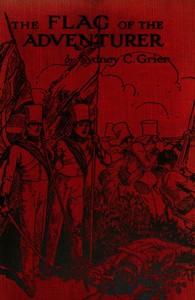
The Flag of the Adventurer by Sydney C. Grier
Published in 1902, The Flag of the Adventurer drops us into the fictional province of Kubbet, a rough-and-tumble corner of the fading Ottoman Empire. Our guide is Captain Jack Ferrers, a young British officer full of zeal and a sincere belief that British administration can bring peace and civilization to a troubled land.
The Story
Jack arrives ready to build roads, settle disputes fairly, and be a force for good. But Kubbet isn't having it. He's immediately caught between warring tribes, suspicious religious leaders, and local officials who see him as a naive nuisance. Every well-meaning rule he tries to enforce backfires. A simple land dispute threatens to ignite a blood feud. His attempts at justice are seen as weakness or insult. The plot follows Jack's growing disillusionment as he realizes that the 'adventure' of empire-building is mostly a messy, thankless slog of political headaches and cultural misunderstandings. The 'flag' he's trying to plant isn't just a piece of cloth; it's a symbol of everything that doesn't quite fit here.
Why You Should Read It
What grabbed me was how current this 120-year-old book feels. It's less a chest-thumping adventure and more a quiet, sharp look at the pitfalls of intervention. Jack isn't a villain; he's a decent guy in over his head. Sydney C. Grier (a pen name for Hilda Gregg) doesn't paint the locals as simple savages or noble heroes either—they're people fiercely protecting their own way of life. You'll spend the whole book mentally yelling at Jack, 'No, don't do that!' while also feeling for him. It's a masterclass in dramatic irony and a surprisingly thoughtful critique of imperialism from right in the middle of its era.
Final Verdict
This isn't a fast-paced swashbuckler. It's a slow-burn political and psychological drama dressed in a pith helmet. Perfect for readers who enjoy historical fiction that makes you think, fans of nuanced character studies, or anyone who's ever wondered what it was really like for those young men sent out to 'run' parts of the world they didn't understand. If you liked the moral complexities in books like The Quiet American but want an Edwardian setting, give this overlooked story a try.
You are viewing a work that belongs to the global public domain. Distribute this work to help spread literacy.
Charles White
1 year agoAfter spending a few days with this digital edition, the nuanced approach to the central theme was better than I expected. It cleared up a lot of the confusion I had previously.
Jessica Taylor
2 years agoThe layout is perfect for tablet and e-reader devices.
Margaret Rodriguez
2 months agoThis was exactly the kind of deep dive I was searching for, the argument presented in the middle section is particularly compelling. A trustworthy resource that I'll keep in my digital library.
William Lopez
9 months agoIt took me a while to process the complex ideas here, but the transition between theoretical knowledge and practical application is seamless. A solid investment for anyone's personal development.








Susan Perez
3 weeks agoFrom a researcher's perspective, the way it handles controversial points with balance is quite professional. Truly a masterpiece of digital educational material.