About 430 minutes
Nestleton Magna: A Story of Yorkshire Methodism — Background and Themes
Technology Airships Imagined Futures
98,723 recorded words. 21 minutes difference from this book's estimate.
View Gutenberg source #41916
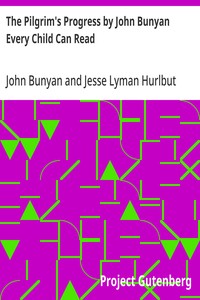
Before opening The Pilgrim's Progress by John Bunyan Every Child Can Read — Key Ideas to Explore, the edition data offers a quick orientation: 103,516 words, 7 hr 31 min estimated reading time, and 14 detected text sections.
The text analysis averages about 22.8 words per sentence, while the detected sections provide another way to judge how the source is divided.
Project Gutenberg metadata also associates the work with “Christian life -- Juvenile literature,” connecting these edition facts with the source record’s subject description.
Explore this collection
These alternatives are selected using recorded categories and estimated reading time.
About 430 minutes
Technology Airships Imagined Futures
98,723 recorded words. 21 minutes difference from this book's estimate.
View Gutenberg source #41916About 481 minutes
Technology Airships Imagined Futures
110,568 recorded words. 30 minutes difference from this book's estimate.
View Gutenberg source #40142About 371 minutes
Technology Airships Imagined Futures
85,199 recorded words. 80 minutes difference from this book's estimate.
View Gutenberg source #39983Search stored excerpts and compare books → Choose by your preferences →
Choices use stored catalog measurements. Estimates vary with reading speed. A shared category is a catalog label, not a claim that two books have the same argument or literary quality.
Search reads excerpt text stored with this catalog and links to its associated Gutenberg record. The connection is stored in the site database; this tool does not recheck that every excerpt is word-for-word identical to that external record. Excerpt search does not cover every chapter and does not verify historical publication dates.
Catalog snapshot checked: 2026-09-26. Coverage: 93 public books, 93 available source excerpts.
Calculated from edition completeness, EPUB availability, text structure and catalogue metadata. Not a user rating.
Total of 100 points, scaled to a 2.5-5.0 range. Editions with an empty description or a missing EPUB file are not scored.
Public-domain source text
The source text is kept in the dedicated reader, separate from this catalogue record and its commentary.
Jesse Lyman Hurlbut’s 1909 edition of The Pilgrim’s Progress is not a simple reprint. In his preface, Hurlbut states his intention to “change the words here and there to simpler ones, and to omit all the conversations and arguments concerning subjects belonging to the field of doctrine.” The result is a version aimed at children ten years old, stripping away the theological discussions that Bunyan originally included for adult readers. The excerpts reveal a text that retains the narrative arc—Christian’s journey, and later Christiana’s—while excising the “short sermons” that Hurlbut considered a “blemish upon the wonderful story.”
Hurlbut’s preface makes explicit his view that Bunyan’s original was “not in the purpose of John Bunyan to write a book for children or even for the young.” He argues that the doctrinal passages are “beyond the minds of children” and cause “great trouble when the book is read.” This edition therefore omits those conversations, focusing on the story itself. The catalog subjects—Christian life – Juvenile literature and Christian pilgrims and pilgrimages – Juvenile literature—align with this simplified approach, though the excerpts show that the text still includes religious language, such as “the Merciful One” and “the Celestial City.” The editorial lens here is clear: the book is presented as a story, not a theological treatise.
The excerpts devote significant space to Christiana’s call to pilgrimage, a portion often abbreviated in other editions. The visitor named Secret delivers a letter “written in letters of gold” that smells of “the best perfume,” and Christiana responds with immediate resolve: “let us pack up, and be gone to the gate.” This episode emphasizes family and repentance—Christiana regrets having “hardened thy heart against his way” and keeping “these thy babes in their ignorance.” The narrative voice remains in the first person (“Now, I saw in my dream”), preserving Bunyan’s dream framework. The inclusion of Christiana’s story suggests that Hurlbut valued the complete narrative arc, not just Christian’s solitary journey.
Comparing the excerpts to the original Bunyan text reveals Hurlbut’s simplifications. For instance, the original’s more complex sentence structures are broken into shorter, clearer units. The dialogue retains its allegorical flavor—“If thou comest in God’s name, come in”—but the surrounding doctrinal exposition is absent. Hurlbut’s preface notes that he aimed to make the story “plain and interesting to children,” and the excerpts bear this out: the narrative moves quickly from Christiana’s dream to the visitor’s arrival to her decision to depart. The word count (103,516) suggests that even with omissions, the book remains substantial, but the reading experience is streamlined for younger audiences.
Readers approaching this edition should note that it is a deliberate adaptation, not a faithful reproduction of Bunyan’s 1678 text. The omissions are purposeful, and the preface provides a clear rationale. For those interested in the original’s theological depth, the complete version remains available. This edition offers a narrative-focused entry point, particularly for younger readers or those seeking the story without the sermons.
I remember first meeting Christiana in that gentle edition of Pilgrim’s Progress, her steps quieter than her husband’s, yet somehow more deliberate—reading it felt less like a sermon and more like sitting beside a friend. That same soft familiarity returned while turning through The Mystery of the Clasped Hands: A Novel — Edition Insights, where secrets rest wrapped in stillness, waiting for a patient hand to unfold them.
Answer a few questions and save a private reflection on this device.