About 365 minutes
Margaret Vincent: A Novel — Key Ideas to Explore
Historical Social Novels
83,905 recorded words. 1 minutes difference from this book's estimate.
View Gutenberg source #39865
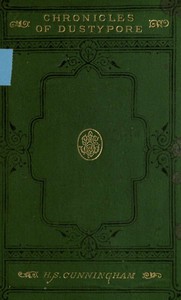
For Chronicles of Dustypore: A Tale of Modern Anglo-Indian Society — A Reader’s Guide, the stored edition analysis reports 83,696 words, 6 hr 4 min estimated reading time, and 10 detected text sections.
The text analysis averages about 22.6 words per sentence, while the detected sections provide another way to judge how the source is divided.
Project Gutenberg metadata also associates the work with “India -- History -- British occupation, 1765-1947 -- Fiction,” connecting these edition facts with the source record’s subject description.
Explore this collection
These alternatives are selected using recorded categories and estimated reading time.
About 365 minutes
Historical Social Novels
83,905 recorded words. 1 minutes difference from this book's estimate.
View Gutenberg source #39865About 355 minutes
Historical Social Novels
81,449 recorded words. 9 minutes difference from this book's estimate.
View Gutenberg source #40996About 345 minutes
Historical Social Novels
79,347 recorded words. 19 minutes difference from this book's estimate.
View Gutenberg source #40795Search stored excerpts and compare books → Choose by your preferences →
Choices use stored catalog measurements. Estimates vary with reading speed. A shared category is a catalog label, not a claim that two books have the same argument or literary quality.
Search reads excerpt text stored with this catalog and links to its associated Gutenberg record. The connection is stored in the site database; this tool does not recheck that every excerpt is word-for-word identical to that external record. Excerpt search does not cover every chapter and does not verify historical publication dates.
Catalog snapshot checked: 2026-09-26. Coverage: 93 public books, 93 available source excerpts.
Calculated from edition completeness, EPUB availability, text structure and catalogue metadata. Not a user rating.
Total of 100 points, scaled to a 2.5-5.0 range. Editions with an empty description or a missing EPUB file are not scored.
Public-domain source text
The source text is kept in the dedicated reader, separate from this catalogue record and its commentary.
Cunningham opens Chronicles of Dustypore with a knowing wink at his readership: 'Any one who knows or cares anything about India—that is, say, one Englishman in a hundred thousand—is familiar with the train of events which resulted in the conquest of the Sandy Tracts.' The narrator’s tone is wry, self-deprecating, and deliberately exclusive, establishing a voice that oscillates between ironic detachment and intimate sympathy. This editorial note examines how the novel’s language and narrative pacing create a distinctive texture, moving from leisurely social observation to moments of heightened emotional and physical tension.
The narrator frequently adopts a sardonic posture toward the Anglo-Indian society he depicts, as when he describes the conquest of the Sandy Tracts as an event that 'nobody but the negotiators understood at the time.' Yet this ironic distance collapses when the focus turns to Maud. In a long passage analyzing her character, the prose becomes almost novelistic in its psychological detail: 'Dissimulation was an art of which life had not as yet taught her the necessity.' The narrator here is not mocking but tender, tracing the contours of a young woman’s inner life with a precision that feels modern. This dual voice—one part clubroom raconteur, one part sympathetic observer—gives the novel its particular texture, allowing Cunningham to critique colonial society while investing deeply in his characters’ emotional realities.
The novel’s rhythm is defined by a contrast between the languid, gossipy pace of Dustypore society and the abrupt, terse sequences set on the frontier. In the excerpt where Sutton describes a military expedition, his speech is clipped and matter-of-fact: 'They are hot, troublesome, inglorious promenades, over country which lames a great many of our horses.' The sentence structure is paratactic, mirroring the weary pragmatism of a soldier. By contrast, the ballroom scenes (implied by chapter titles like 'The First Ball' and 'The Woes of a Chaperon') likely move with a different tempo—leisurely, filled with dialogue and social maneuvering. This alternation prevents the novel from settling into a single gear, keeping the reader alert to shifts in mood and stakes.
The opening epigraph—'Sown in a wrinkle of the monstrous hill, / The city sparkles like a grain of salt'—establishes a landscape that is both vast and confining. The 'Sandy Tracts' and 'Dustypore' itself suggest aridity and insignificance, a setting that mirrors the social constraints placed on characters like Maud. When Maud confesses that 'there are things in it that hurt one, for all that,' the landscape becomes a metaphor for emotional restriction. Later, Sutton points to the Black Mountain and a pass 'where we shall be marching,' contrasting the open, dangerous frontier with the enclosed social world. This recurring imagery of dust, salt, and distant hills reinforces the tension between the desire for freedom and the reality of confinement—both geographical and social.
Readers approaching Chronicles of Dustypore should attend to the way Cunningham modulates his narrator’s voice: the same pen that sketches a satirical portrait of colonial bureaucracy can, in the next chapter, render a young woman’s emotional turmoil with delicate precision. The novel rewards attention to its shifts in pace and its use of landscape as a psychological mirror. It is a work that asks to be read not merely as a period piece but as a carefully constructed study of the tensions—between irony and sympathy, society and solitude, the drawing room and the frontier—that defined Anglo-Indian life.
Reading Chronicles of Dustypore again, I keep noticing how Cunningham's delicate comedy papers over the quiet ache beneath Sutten's choices. Maud's story lingers longer than the frontier set-pieces. That same ache—of a life shaped by omissions rather than actions—is what I found in the notes accompanying The Girl Who Had Nothing — Reading Notes. Some books, after you close them, leave a particular shade of evening light behind.
Capture what you thought, learned, and would like to remember.