About 300 minutes
The Yellow House; Master of Men — Inside the Classic
Historical Social Novels
68,947 recorded words. 6 minutes difference from this book's estimate.
View Gutenberg source #41402
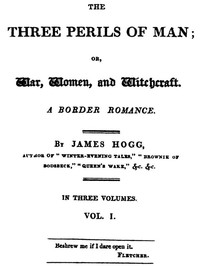
Before opening The Three Perils of Man; or, War, Women, and Witchcraft, Vol. 1 (of 3) — Themes and Context, the edition data offers a quick orientation: 67,425 words, 4 hr 54 min estimated reading time, and 8 detected text sections.
The text analysis averages about 24.1 words per sentence, while the detected sections provide another way to judge how the source is divided.
Project Gutenberg metadata also associates the work with “Historical fiction,” connecting these edition facts with the source record’s subject description.
Explore this collection
These alternatives are selected using recorded categories and estimated reading time.
About 300 minutes
Historical Social Novels
68,947 recorded words. 6 minutes difference from this book's estimate.
View Gutenberg source #41402About 287 minutes
Historical Social Novels
65,994 recorded words. 7 minutes difference from this book's estimate.
View Gutenberg source #40539About 302 minutes
Historical Social Novels
69,403 recorded words. 8 minutes difference from this book's estimate.
View Gutenberg source #39432Search stored excerpts and compare books → Choose by your preferences →
Choices use stored catalog measurements. Estimates vary with reading speed. A shared category is a catalog label, not a claim that two books have the same argument or literary quality.
Search reads excerpt text stored with this catalog and links to its associated Gutenberg record. The connection is stored in the site database; this tool does not recheck that every excerpt is word-for-word identical to that external record. Excerpt search does not cover every chapter and does not verify historical publication dates.
Catalog snapshot checked: 2026-09-26. Coverage: 93 public books, 93 available source excerpts.
Calculated from edition completeness, EPUB availability, text structure and catalogue metadata. Not a user rating.
Total of 100 points, scaled to a 2.5-5.0 range. Editions with an empty description or a missing EPUB file are not scored.
Public-domain source text
The source text is kept in the dedicated reader, separate from this catalogue record and its commentary.
James Hogg's The Three Perils of Man; or, War, Women, and Witchcraft (1822) begins not with a character but with a sweeping historical claim: the days of the Stuart kings were 'the days of chivalry and romance.' The opening chapter establishes a narrator who speaks of 'our fathers' and the 'successful and glorious issue' of Scotland's wars, immediately grounding the story in a nationalistic, retrospective tone. Yet this lofty voice is undercut by the chapter's epigraph—a ballad fragment warning of a 'warlock wight'—and by the rapid shift to a tense council scene inside an English-held castle. The juxtaposition of antiquarian grandeur and immediate, gritty dialogue sets up a work that moves between epic framing and close-up conflict.
Each chapter in the excerpts is headed by a stanza from an 'Old Song,' a practice that signals Hogg's debt to border balladry. The first epigraph introduces a king, a daughter, and a 'warlock wight,' but the narrative that follows does not directly recount that story; instead, it offers a historical essay on Scottish chivalry. This gap between the ballad's implied plot and the narrator's own agenda creates a layered reading experience. The epigraphs function as thematic cues—here, hinting at supernatural peril—rather than summaries. Readers should watch for how these snippets of song resonate with or diverge from the prose action, a technique that rewards attention to paratext.
The most vivid passage in the excerpts is the council of English soldiers debating whether to surrender. Hogg renders the scene through physical detail: 'their brows were plaited down,' 'every mouth shaped like a curve,' and 'every man's right hand instinctively rested on the hilt of his sword.' The dialogue is clipped and defiant—'I'll eat the one arm, and defend the draw-bridge with the other'—and the collective mood shifts from 'bitter and obstinate rumination' to a 'wild gleam of ferocity.' This is not a generic war council; it is a study in group psychology, where the narrator lingers on posture and silence before the first word is spoken. The scene demonstrates Hogg's ability to build tension through blocked action and delayed speech.
Amid the military plotting, a quieter thread emerges: the page Colin Roy, who occupies a 'little apartment' near Douglas's pavilion and 'never mixed or conversed with the other pages.' A character muses that there is 'a sort of enchantment about him' and that his voice 'overcomes me.' The narrator adds a cryptic aside: 'Alas! that Douglas did not know the value of the life he left exposed.' These details, drawn from different parts of the excerpts, hint at a supernatural or romantic subplot without revealing its nature. The page's isolation and the repeated word 'enchantment' align with the 'witchcraft' promised in the title, but the excerpts do not confirm whether Colin is human or otherworldly. This ambiguity is a deliberate narrative strategy.
Hogg's prose moves between three distinct registers: the declamatory historical voice of the opening, the colloquial urgency of the council dialogue, and the introspective, almost Gothic tone of the passages concerning Colin Roy and the pavilion. The narrator shifts from 'our fathers' to 'the demon of animosity' to a character's private resolve: 'I can love, but have not learned to submit.' This variety can disorient a first-time reader, but it also mirrors the novel's subtitle—'War, Women, and Witchcraft'—by oscillating between public conflict, personal emotion, and hinted mystery. Pay attention to who is speaking and in what mode; the novel's texture depends on these abrupt transitions.
Because the excerpts cover only the opening chapters and a later council scene, the full trajectory of the plot—especially the roles of war, women, and witchcraft—remains unclear. What is evident is Hogg's craft in juxtaposing historical rhetoric with intimate, gestural detail. A first reading benefits from noting how the epigraphs, the council's physicality, and the enigmatic page each establish a different narrative key. The novel rewards patience with its shifts in tone and its willingness to leave motives unexplained.
There’s something in Hogg’s council scene—that exhausted hush before the English decide—that lingers long after the page is turned. I kept thinking how wars are argued in such rooms, then remembered reading A Lost Cause — A Reader’s Guide and feeling that same quiet ache. Momentary, unfinished. Some books just leave you holding your breath. A Lost Cause — A Reader’s Guide comes to mind that way, gently, like a half-remembered song.
Use these questions to collect your thoughts before moving on.