About 166 minutes
The Affair at the Inn — Inside the Classic
Historical Social Novels
37,973 recorded words. 10 minutes difference from this book's estimate.
View Gutenberg source #40879
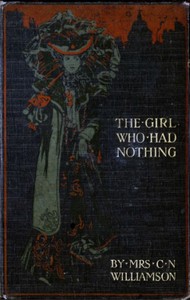
The catalog record for The Girl Who Had Nothing — Reading Notes provides practical reading context through 40,251 words, 2 hr 56 min estimated reading time, and 15 detected text sections.
The text analysis averages about 19.2 words per sentence, while the detected sections provide another way to judge how the source is divided.
Project Gutenberg metadata also associates the work with “Young women -- Fiction,” connecting these edition facts with the source record’s subject description.
Explore this collection
These alternatives are selected using recorded categories and estimated reading time.
About 166 minutes
Historical Social Novels
37,973 recorded words. 10 minutes difference from this book's estimate.
View Gutenberg source #40879About 220 minutes
Historical Social Novels
50,515 recorded words. 44 minutes difference from this book's estimate.
View Gutenberg source #42768About 222 minutes
Historical Social Novels
50,991 recorded words. 46 minutes difference from this book's estimate.
View Gutenberg source #40343Search stored excerpts and compare books → Choose by your preferences →
Choices use stored catalog measurements. Estimates vary with reading speed. A shared category is a catalog label, not a claim that two books have the same argument or literary quality.
Search reads excerpt text stored with this catalog and links to its associated Gutenberg record. The connection is stored in the site database; this tool does not recheck that every excerpt is word-for-word identical to that external record. Excerpt search does not cover every chapter and does not verify historical publication dates.
Catalog snapshot checked: 2026-09-26. Coverage: 93 public books, 93 available source excerpts.
Calculated from edition completeness, EPUB availability, text structure and catalogue metadata. Not a user rating.
Total of 100 points, scaled to a 2.5-5.0 range. Editions with an empty description or a missing EPUB file are not scored.
Public-domain source text
The source text is kept in the dedicated reader, separate from this catalogue record and its commentary.
The novel opens with a twelve-year-old Joan Carthew reasoning her way through a birthday she infers from a dim memory of presents on the 13th of May. The narrator’s voice is brisk and slightly ironic, noting that her “running away from home” is less festive than it sounds—she is a non-paying guest in a Brighton lodging-house, put to work answering bells and cleaning boots. The prose moves quickly through exposition, compressing years into a few paragraphs, then slows into scene-by-scene action as Joan, now a young woman, arrives in London. This shift from summary to dramatized encounter marks the first change in pace.
Joan’s speech is consistently purposeful. When she visits the ailing Mrs. Gone, she brings a rose and says, “Because I’m sorry you are ill, and perhaps lonely”—a line the narrator notes is “able for once to account for an action without a single mental reserve.” Elsewhere, Joan “had her own way of dressing the truth,” telling Mrs. Gone that Miss Witt feared she was in trouble, when in fact Joan had merely been curious. The narrator frequently glosses Joan’s motives, creating a layered effect: the reader sees both what Joan says and what she withholds. This double-layered dialogue recurs throughout the excerpts, suggesting a pattern of strategic candor that defines the protagonist’s interactions.
The first chapter compresses Joan’s childhood into a few dense paragraphs, using phrases like “eons of years ago” to signal a leap in time. Once Joan reaches London, the narrative slows to a near-stillness in Mrs. Gone’s room. The old woman’s “strange face” and “voice which would have made the fortune of a tragic actress” are described in lingering detail. Joan’s internal questions—“Am I a soft-hearted idiot… or is there something in my odd feeling?”—introduce a reflective pause. The pacing thus alternates between rapid summary and extended, almost theatrical scenes, a rhythm that may continue as the plot develops.
The boarding-house at Woburn Place is a microcosm of precarious respectability. Joan studies “Society and financial papers” for “hopeful suggestion,” and the boarders are assessed as potential “stepping-stones.” Mrs. Gone’s unpaid room and sparse meals underscore the economic anxieties that pervade the novel. The narrator notes that Mrs. Gone “ate almost nothing” and refused a doctor, adding to the atmosphere of concealed suffering. These details—the rose laid on a pile of plates, the shaded lamp, the landlady’s slaps—build a tangible world where every object and gesture carries social weight. The setting is not merely backdrop but a force that shapes Joan’s calculations.
Readers may find it useful to track how Joan’s internal calculations compare with her spoken words, especially in scenes where the narrator withholds judgment. The boarding-house setting rewards attention to minor characters—the landlady, Miss Witt, the other boarders—as potential catalysts. The novel’s title invites speculation about what Joan lacks, but the excerpts suggest she possesses a sharp, pragmatic intelligence that may prove more valuable than money or family.
I closed The Girl Who Had Nothing thinking about how a voice can carry a whole story, and it made me softly recall another old novel where a single narrator holds the weight of everything. There is a quiet kinship there—both trust the character’s words to reveal more than events alone. That older one, The Story of Francis Cludde — Inside the Classic, lingers with the same patient warmth.
Use these questions to collect your thoughts before moving on.