About 416 minutes
The Young Lovell: A Romance — Themes and Context
Historical Social Novels
95,565 recorded words. 3 minutes difference from this book's estimate.
View Gutenberg source #42801
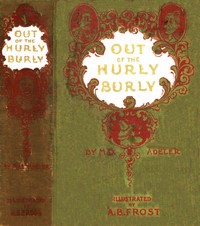
Out of the Hurly-Burly; Or, Life in an Odd Corner — Edition Insights can be approached with a clearer sense of reading commitment from its source measurements: 96,353 words, 6 hr 59 min estimated reading time, and 14 detected text sections.
The text analysis averages about 20.7 words per sentence, while the detected sections provide another way to judge how the source is divided.
Project Gutenberg metadata also associates the work with “Humorous stories,” connecting these edition facts with the source record’s subject description.
Explore this collection
These alternatives are selected using recorded categories and estimated reading time.
About 416 minutes
Historical Social Novels
95,565 recorded words. 3 minutes difference from this book's estimate.
View Gutenberg source #42801About 399 minutes
Historical Social Novels
91,623 recorded words. 20 minutes difference from this book's estimate.
View Gutenberg source #41168About 395 minutes
Historical Social Novels
90,712 recorded words. 24 minutes difference from this book's estimate.
View Gutenberg source #40571Search stored excerpts and compare books → Choose by your preferences →
Choices use stored catalog measurements. Estimates vary with reading speed. A shared category is a catalog label, not a claim that two books have the same argument or literary quality.
Search reads excerpt text stored with this catalog and links to its associated Gutenberg record. The connection is stored in the site database; this tool does not recheck that every excerpt is word-for-word identical to that external record. Excerpt search does not cover every chapter and does not verify historical publication dates.
Catalog snapshot checked: 2026-09-26. Coverage: 93 public books, 93 available source excerpts.
Calculated from edition completeness, EPUB availability, text structure and catalogue metadata. Not a user rating.
Total of 100 points, scaled to a 2.5-5.0 range. Editions with an empty description or a missing EPUB file are not scored.
Public-domain source text
The source text is kept in the dedicated reader, separate from this catalogue record and its commentary.
Charles Heber Clark, writing as Max Adeler, opens his 1874 novel with a dedication to 'the intelligent compositor'—a typesetter whose accidental substitutions, such as turning 'filtration is sometimes accomplished with the assistance of albumen' into 'flirtation is sometimes accomplished with the resistance of aldermen,' he celebrates as a source of 'laughter that is worth a hundred groans.' This framing announces a book built on verbal mishap and domestic absurdity. Yet the excerpts also reveal a starkly different register: a scene of a young woman, Mary, accused of theft, fleeing through a storm-tossed night, her 'brain in a whirl,' contemplating suicide before collapsing at her mother's feet. The catalog labels 'humorous stories' and 'American fiction—19th century' accurately describe the book's genre but do not prepare a reader for this sudden plunge into melodrama.
Clark's dedication is not mere whimsy. It establishes a compositional method: the humorist as grateful recipient of the compositor's blunders. The examples he cites—'Where are the dead, the varnished dead?' for a mis-set line about comets, or 'a count slept in the haymow in a traveling shirt'—are not just jokes but evidence of a collaborative, almost aleatory approach to comedy. The preface further notes that many incidents 'have already appeared in print' and been widely copied, sometimes attributed to others. This suggests the book is a collection of previously published sketches, stitched into a narrative. The humor, then, is not tightly plotted but episodic, reliant on the kind of happy accident Clark praises. Readers encountering the novel should expect a loose structure where set pieces and verbal play take precedence over sustained character development.
The extended excerpt from what appears to be a later chapter shifts tone dramatically. Mary, accused of stealing a brooch, flees a party. The prose becomes heightened: 'The stars that lighted her upon her mad journey twinkled through the frosty air with an intelligence they had never before possessed.' The narrator describes her 'wild passion and her misery' as she struggles through 'mire and mud' and 'the high grass and the reeds of the water's edge.' This is the language of sentimental fiction, not farce. The dialogue that follows—between Major Newton, Mrs. Willitts, and the doctor—is a conventional mystery setup: the doctor vows to 'unravel this mystery and clear this innocent girl.' The scene ends with the company dispersing as 'eager gossips' to spread the story. The contrast with the dedication's tone is stark, suggesting that Clark's humor may be a frame for more conventional Victorian plot devices.
The Project Gutenberg record classifies Out of the Hurly-Burly under 'Humorous stories' and 'American fiction—19th century,' with a secondary topic of 'humor-satire.' These labels are not wrong, but they are incomplete. The excerpts show a work that oscillates between two modes: the genial, typo-celebrating humor of the front matter and the earnest melodrama of Mary's flight. The catalog does not flag this tonal instability. A reader expecting consistent comedy may be disoriented by the sudden seriousness. Conversely, a reader seeking a straightforward sentimental novel will find the dedication puzzling. The book's subtitle, 'Life in an Odd Corner,' hints at this patchwork quality. The 'odd corner' may be not just a setting but a literary space where comic and tragic conventions coexist, sometimes jarringly. The catalog's broad subjects, while accurate, obscure the work's generic hybridity.
Clark's novel rewards a reader willing to accept its shifts in register. The dedication and preface offer a key: the book is a collection, assembled with a compositor's luck. The melodramatic scenes may be earlier sketches repurposed, or they may represent a deliberate counterpoint. Pay attention to how the humor and the pathos are juxtaposed—whether they comment on each other or simply coexist. The illustrations by A. B. Frost and Frederic B. Schell, mentioned on the title page, may further modulate the tone. This is a book that asks to be read not as a unified narrative but as a cabinet of curiosities, where a typesetter's error and a maiden's distress share the same shelf.
I keep thinking about that theft accusation scene in Out of the Hurly-Burly, how the laughter turns so quietly tender. There’s a similar ache tucked inside The Honey-Pot — Inside the Classic, that same odd corner where humor and melancholy share a porch. It’s just nice to know some books still hold both at once.
A brief reflection can help important ideas stay with you longer.