About 917 minutes
Miss Marjoribanks — Reading Notes
Historical Social Novels
210,770 recorded words. 82 minutes difference from this book's estimate.
View Gutenberg source #41286
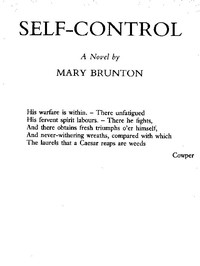
Self-control: A Novel — A Closer Reading can be approached with a clearer sense of reading commitment from its source measurements: 191,832 words, 13 hr 55 min estimated reading time, and 16 detected text sections.
The text analysis averages about 24.6 words per sentence, while the detected sections provide another way to judge how the source is divided.
Project Gutenberg metadata also associates the work with “Women -- Fiction,” connecting these edition facts with the source record’s subject description.
Explore this collection
These alternatives are selected using recorded categories and estimated reading time.
About 917 minutes
Historical Social Novels
210,770 recorded words. 82 minutes difference from this book's estimate.
View Gutenberg source #41286About 959 minutes
Historical Social Novels
220,450 recorded words. 124 minutes difference from this book's estimate.
View Gutenberg source #40915About 1,007 minutes
Historical Social Novels
231,402 recorded words. 172 minutes difference from this book's estimate.
View Gutenberg source #40928Search stored excerpts and compare books → Choose by your preferences →
Choices use stored catalog measurements. Estimates vary with reading speed. A shared category is a catalog label, not a claim that two books have the same argument or literary quality.
Search reads excerpt text stored with this catalog and links to its associated Gutenberg record. The connection is stored in the site database; this tool does not recheck that every excerpt is word-for-word identical to that external record. Excerpt search does not cover every chapter and does not verify historical publication dates.
Catalog snapshot checked: 2026-09-26. Coverage: 93 public books, 93 available source excerpts.
Calculated from edition completeness, EPUB availability, text structure and catalogue metadata. Not a user rating.
Total of 100 points, scaled to a 2.5-5.0 range. Editions with an empty description or a missing EPUB file are not scored.
Public-domain source text
The source text is kept in the dedicated reader, separate from this catalogue record and its commentary.
Mary Brunton's Self-Control announces its moral purpose in the preface, where the author likens her fiction to a 'sweetmeat' concealing medicine. Yet the novel's craft resists simple didacticism. In the excerpted scene, Laura Montreville's physical collapse—'the pencils dropped from Laura's hand'—is triggered not by a direct threat but by overheard gossip about Colonel Hargrave. Brunton renders Laura's internal crisis through bodily detail: her breath shortens, her heart 'seemed to pause,' and she faints before any confession is made. This reliance on somatic symptoms rather than interior monologue reflects an authorial choice to dramatize self-control as a visible, corporeal struggle.
Brunton's preface to Self-Control is an unusual piece of authorial positioning. She addresses Joanna Baillie, praising Baillie's Plays on the Passions as 'powerful warnings to watch the first risings of the insidious rebel.' Brunton then claims affinity with that project, stating that 'the regulation of the passions is the province, it is the triumph of Religion.' This is not mere flattery; it signals a structural principle. The novel will trace the 'progress and consequences of passion' through a heroine whose religious principle is tested by ambition, want, sorrow, displeasure, timidity, misplaced affection, and fear. Brunton also disarmingly admits the work began 'merely for my own amusement,' and she hopes the 'avowal of a useful purpose' will make readers tolerate what might otherwise seem unworthy. This preface functions as a contract: the reader is warned that moral instruction is the intended effect, even if delivered through entertaining fiction.
In the excerpt, Lady Pelham and her visitor engage in a conversation that is less exchange than assault. The visitor opens with a theatrical question—'Who does your ladyship think bowed to me en passant?'—and immediately supplies the answer: Lady Bellamer. The tone is one of scandalized delight. Lady Pelham matches it: 'Indeed, I think, in common modesty, she should have waited for your notice!' The dialogue is rapid, laced with social codes. When the visitor reports that 'Hargrave is determined not to marry her,' Lady Pelham retorts that a man would be 'a great fool to marry where he has had such damning proofs of frailty.' The word 'frailty' is a euphemism for adultery, and the mention of a 'crim. con.' (criminal conversation) suit makes the scandal explicit. Brunton uses this brittle, knowing dialogue to show how reputation is dissected in drawing-room talk. Laura, the silent auditor, becomes the victim of this verbal violence; her physical collapse is the only response available to her.
Brunton repeatedly turns to Laura's body to express what she cannot say. When the visitor mentions Hargrave's duel, 'the pencils dropped from Laura's hand.' Her breath comes short; her heart 'seemed to pause for a moment, and then to redouble its beating.' She tries to leave the room, but 'fainted.' This is not melodrama for its own sake. The fainting is a public event—Lady Pelham calls for help and immediately begins to interrogate Laura: 'What has been the matter my dear? What made you ill? Did any thing affect you?' Laura's silence and closed eyes are a refusal to explain. Brunton thus makes the body the site of a conflict that cannot be spoken. The novel's title, Self-Control, is here enacted as a failure of control: Laura's body betrays her secret. Yet the author does not grant her a voice to reclaim the narrative. The reader must infer the connection between Hargrave's name and Laura's collapse, just as Lady Pelham does: 'wondering whether it could have any possible connection with Colonel Hargrave.'
Brunton constructs a social world where every gesture is watched and interpreted. Lady Pelham's character is established through her judgments: she finds Mrs De Courcy 'the best woman in the world, but a virtue, she said, so cased in armour, necessarily precluded all grace or attraction.' Harriet De Courcy is 'a little sarcastic coquette.' Laura, caught between defending her friends and angering her aunt, 'ceased to mention the De Courcys at all.' This is a world of constant surveillance and misreading. Even Laura's love for the De Courcys is described as 'a pardonable spirit of contradiction.' The natural world offers a contrast: Laura longs for the country, counting days until she can see 'the joyous face of nature.' But the novel's setting is primarily the drawing-room, where reputation is made and unmade. Brunton's attention to the nuances of social performance—the 'usual speeches,' the calculated pauses, the feigned ignorance—creates a texture of anxiety that makes Laura's eventual loss of control feel inevitable.
Readers approaching Self-Control should attend to the ways Brunton embeds moral argument in physical and social detail. The preface offers a clear statement of intent, but the novel's power lies in its silences, its bodily symptoms, and its sharp-edged dialogue. Laura Montreville is a heroine defined by what she cannot say; her story unfolds through the reactions of others and the involuntary testimony of her own frame. This is a novel that rewards close attention to the spaces between words.
I keep thinking about how Laura’s fainting spell in Self-control reveals so much through what her body does before her mind can catch up. Later, I found myself recalling that same quiet dread while reading When It Was Dark: The Story of a Great Conspiracy — Context and Discussion. There’s a shared hush there, a sense of worlds tilting just out of sight. Strange, how two different stories can hold the same shadow.
Use these questions to collect your thoughts before moving on.