About 365 minutes
The City of Masks — Inside the Classic
Exploration Survival Adventure Tales
83,766 recorded words. 30 minutes difference from this book's estimate.
View Gutenberg source #40146
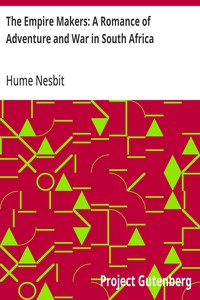
Before opening The Empire Makers: A Romance of Adventure and War in South Africa — Text and Context, the edition data offers a quick orientation: 90,729 words, 6 hr 35 min estimated reading time, and 10 detected text sections.
The text analysis averages about 18.2 words per sentence, while the detected sections provide another way to judge how the source is divided.
Project Gutenberg metadata also associates the work with “South African War, 1899-1902 -- Fiction,” connecting these edition facts with the source record’s subject description.
Explore this collection
These alternatives are selected using recorded categories and estimated reading time.
About 365 minutes
Exploration Survival Adventure Tales
83,766 recorded words. 30 minutes difference from this book's estimate.
View Gutenberg source #40146About 357 minutes
Exploration Survival Adventure Tales
81,925 recorded words. 38 minutes difference from this book's estimate.
View Gutenberg source #39857About 356 minutes
Exploration Survival Adventure Tales
81,703 recorded words. 39 minutes difference from this book's estimate.
View Gutenberg source #42441Search stored excerpts and compare books → Choose by your preferences →
Choices use stored catalog measurements. Estimates vary with reading speed. A shared category is a catalog label, not a claim that two books have the same argument or literary quality.
Search reads excerpt text stored with this catalog and links to its associated Gutenberg record. The connection is stored in the site database; this tool does not recheck that every excerpt is word-for-word identical to that external record. Excerpt search does not cover every chapter and does not verify historical publication dates.
Catalog snapshot checked: 2026-09-26. Coverage: 93 public books, 93 available source excerpts.
Calculated from edition completeness, EPUB availability, text structure and catalogue metadata. Not a user rating.
Total of 100 points, scaled to a 2.5-5.0 range. Editions with an empty description or a missing EPUB file are not scored.
Public-domain source text
The source text is kept in the dedicated reader, separate from this catalogue record and its commentary.
Hume Nesbit's The Empire Makers opens not on the veldt but in the schoolyard of Shebourne Academy, where Ned Romer, Clarence Raybold, and Fred Weldon are introduced as paragons of Victorian boyhood: 'three braver, franker, and more chivalrous hearts never beat in male breasts.' The preface immediately establishes the novel's polemical stance, framing the Second Boer War as a 'war of Justice and Right' and the Boers as 'ignorant savages.' This dual identity—part schoolboy adventure, part imperialist tract—shapes every subsequent episode, from the trio's run-ins with the Transvaal government to their discovery of an ancient Central African nation. The excerpts reveal a narrative that oscillates between precise survival details (quinine doses, leopard hunts) and broad ideological assertions, creating a distinctive tension between the concrete and the rhetorical.
The preface functions as a political manifesto, not a conventional introduction. Nesbit directly addresses readers as 'Imperialists' and 'pro-Boers,' urging the former to remain steadfast and the latter to convert. The language is deliberately confrontational: 'Who would not sooner share the grave of a soldier in Africa than grasp the hand of a pro-Boer in England?' This framing colours every subsequent event. When the heroes later 'take a little hand in this present war,' their actions are pre-interpreted as righteous. The preface also reveals the novel's intended audience—those already sympathetic to the imperial cause—and its rhetorical strategy: to make adventure serve as propaganda. Notably, the preface's emotional appeal ('drop a tear over their sacred graves') contrasts with the brisk, matter-of-fact tone of the adventure chapters, suggesting a deliberate layering of sentiment and action.
The excerpts show a marked attention to practical survival details that ground the adventure in verisimilitude. Ned Romer administers quinine 'regularly to each man two grains' and repeats the dose 'every half-hour' when fever appears. The narrative catalogues threats methodically: 'wild beasts and savages they scared with their gunpowder and bullets. The malaria they fought with their medicine-chest. The insect pests they endured with philosophy.' This tripartite structure—violence, pharmacology, endurance—reflects a Victorian faith in systematic problem-solving. Clarence's recurring depression, attributed to a 'knock on the head by the Boers,' is treated as a medical rather than a moral failing. The dead leopard is skinned for its pelt, but the decision to abandon the skins ('we cannot cart any more luggage') introduces a note of practical sacrifice. These details suggest a narrative that values competence as much as courage.
Nesbit devotes unusual attention to the auditory environment of the African night. The camp is surrounded by 'howlings, sharp cries, and vibrating roarings of hungry animals,' while frogs produce 'an increasing chorus, running up and down the scale of notes, from the deep bass of the bull to the reed-like treble of the tender froglet.' Mosquitoes add 'irritating and brisk humming.' Ned's comment—'No one could feel lonely while this concert went on'—treats the soundscape as a companionable nuisance rather than a threat. This sensory detail contrasts with the more abstract imperial rhetoric elsewhere. The passage also reveals a hierarchy of attention: the leopard's death-throes are described clinically, while the frogs are given a musical metaphor. Such choices indicate where the author's descriptive interest genuinely lies—not in the grand sweep of empire, but in the immediate, textured experience of the bush.
Readers should note that the excerpts represent only a fraction of the novel's 90,000 words, and the Central African 'ancient nation' mentioned in the preface does not appear in these samples. The tone shifts markedly between the preface's polemic and the chapters' adventure prose; the latter is more restrained and detail-oriented. Pay attention to how Nesbit balances the trio's schoolboy camaraderie with the harsh demands of survival, and whether the imperialist frame ever constrains the narrative's freedom. The novel rewards those interested in the intersection of popular fiction and political advocacy at the turn of the century.
Flipping through The Empire Makers, I paused on the schoolmates’ first night under the veldt stars, that odd comfort in shared silence. It carried me straight back to a quieter guide I keep nearby, The Wilderness Castaways — A Reader’s Guide, which lingers on similar moments of being lost, yet oddly at home. Both hold that strange tenderness.
Your answers remain private and are stored only in this browser.