About 168 minutes
The Last Call: A Romance (Vol. 2 of 3) — Story, Setting & Ideas
Exploration Survival Adventure Tales
38,596 recorded words. 4 minutes difference from this book's estimate.
View Gutenberg source #42596
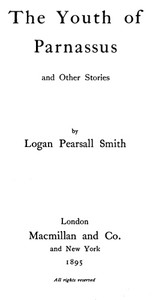
The Youth of Parnassus, and Other Stories — Edition Insights can be approached with a clearer sense of reading commitment from its source measurements: 39,371 words, 2 hr 52 min estimated reading time, and 4 detected text sections.
The text analysis averages about 18.9 words per sentence, while the detected sections provide another way to judge how the source is divided.
Project Gutenberg metadata also associates the work with “Short stories,” connecting these edition facts with the source record’s subject description.
Explore this collection
These alternatives are selected using recorded categories and estimated reading time.
About 168 minutes
Exploration Survival Adventure Tales
38,596 recorded words. 4 minutes difference from this book's estimate.
View Gutenberg source #42596About 252 minutes
Exploration Survival Adventure Tales
57,733 recorded words. 80 minutes difference from this book's estimate.
View Gutenberg source #41186About 259 minutes
Exploration Survival Adventure Tales
59,382 recorded words. 87 minutes difference from this book's estimate.
View Gutenberg source #41790Search stored excerpts and compare books → Choose by your preferences →
Choices use stored catalog measurements. Estimates vary with reading speed. A shared category is a catalog label, not a claim that two books have the same argument or literary quality.
Search reads excerpt text stored with this catalog and links to its associated Gutenberg record. The connection is stored in the site database; this tool does not recheck that every excerpt is word-for-word identical to that external record. Excerpt search does not cover every chapter and does not verify historical publication dates.
Catalog snapshot checked: 2026-09-26. Coverage: 93 public books, 93 available source excerpts.
Calculated from edition completeness, EPUB availability, text structure and catalogue metadata. Not a user rating.
Total of 100 points, scaled to a 2.5-5.0 range. Editions with an empty description or a missing EPUB file are not scored.
Public-domain source text
The source text is kept in the dedicated reader, separate from this catalogue record and its commentary.
Logan Pearsall Smith’s 1895 collection opens with an American student arriving at Oxford under a large umbrella, his “long, black broadcloth coat of provincial cut” marking him as an outsider. The narrator’s initial misidentification—first as a tourist, then as a mission agent—establishes a pattern of misreading that runs through these stories. Smith’s diction is precise: the umbrella moves with an “undecided motion,” and the young man’s voice is “very unusual” in accent. These small observations accumulate into a portrait of social friction and self-consciousness.
Smith’s choice of words often signals a character’s social position or emotional state. The American’s cautious reply—“I guess I will; though it does seem kind of old and mouldy”—uses colloquial hedging that contrasts with Foley’s clipped internal monologue. The narrator notes the “melancholy footsteps” mounting the stairs, a detail that personifies sound and foreshadows the young man’s isolation. Later, in “A Broken Journey,” Arthur Lestrange’s thoughts are rendered through restless physical actions: he “changed his seat restlessly,” “rearranged his luggage,” and “looked at himself in the mirror, caressing his slight moustache.” Smith avoids direct psychological exposition, letting verbs and gestures convey anxiety.
Conversations in these stories rarely advance plot; instead they reveal what characters withhold. The American answers Foley’s questions “with the usual shyness,” but the content is banal—travel dates and college arrangements. What matters is the gap between what is said and what is felt. In “The Will to Live,” dialogue is similarly oblique. When Arthur tells himself “Good old ruin,” the phrase is half-aloud, a private exclamation that the reader overhears but other characters do not. Smith uses such fragments to suggest inner turmoil without explicit confession. The effect is a world where speech is a performance, and true feeling emerges in asides or silences.
Several stories hinge on journeys that are interrupted or incomplete. “A Broken Journey” begins with Arthur waiting at Paddington, the train’s departure described in sensory detail: “the shaking and noise of travel,” the “green flag was waved.” Yet the journey’s purpose—a meeting with a woman—is never directly stated; instead, Smith gives us Arthur’s fantasies of “a dog-cart, with shining bay horse” and the anticipation of “pretended indifference.” The narrative withholds the arrival, ending before the encounter. This structural choice mirrors the characters’ inability to commit or connect. Similarly, “The Youth of Parnassus” ends with the American still an outsider, his integration unresolved.
Smith seeds his stories with objects that carry emotional weight. The umbrella in the opening story is not just a prop; its “undecided motion” and later collapse signal the American’s awkwardness. In “A Broken Journey,” Arthur looks at himself in the mirror, “caressing his slight moustache,” a gesture of vanity and nervousness. Trains appear repeatedly—not as mere transport but as spaces of liminality. The wheels beat “an unquiet and delicious measure” that echoes Arthur’s excitement. These recurring details create a cohesive texture across the collection, linking disparate characters through shared modes of perception. Smith’s world is one where objects and movements speak louder than direct statement.
Readers attentive to Smith’s craft will find a writer more interested in the spaces between words than in dramatic action. His characters are defined by what they almost say, by the objects they handle, and by the journeys they begin but do not complete. The collection rewards slow reading: notice the weight of a single adjective, the rhythm of a hesitant reply. These stories do not offer resolution, but they do offer a precise, unsentimental portrait of young men caught between desire and restraint.
I’ve always been fond of that old Parnassus collection—those young men, so caught between what they say and what they feel, as if language itself were a shyness. It puts me in mind of another quiet volume, Quintus Oakes: A Detective Story — Edition Insights, where the same hush hangs over every clue. Both hold their secrets patiently, waiting for a reader who listens.
Use these questions to collect your thoughts before moving on.