About 172 minutes
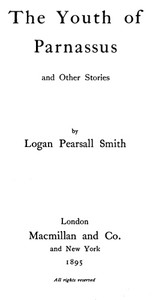
The Youth of Parnassus, and Other Stories — Edition Insights
Exploration Survival Adventure Tales
39,371 recorded words. 4 minutes difference from this book's estimate.
View Gutenberg source #41682

The source record for The Last Call: A Romance (Vol. 2 of 3) — Story, Setting & Ideas measures this digital text at 38,596 words, 2 hr 48 min estimated reading time, and 5 detected text sections.
The text analysis averages about 18.1 words per sentence, while the detected sections provide another way to judge how the source is divided.
Project Gutenberg metadata also associates the work with “Man-woman relationships -- Fiction,” connecting these edition facts with the source record’s subject description.
Explore this collection
These alternatives are selected using recorded categories and estimated reading time.
About 172 minutes
Exploration Survival Adventure Tales
39,371 recorded words. 4 minutes difference from this book's estimate.
View Gutenberg source #41682About 252 minutes
Exploration Survival Adventure Tales
57,733 recorded words. 84 minutes difference from this book's estimate.
View Gutenberg source #41186About 259 minutes
Exploration Survival Adventure Tales
59,382 recorded words. 91 minutes difference from this book's estimate.
View Gutenberg source #41790Search stored excerpts and compare books → Choose by your preferences →
Choices use stored catalog measurements. Estimates vary with reading speed. A shared category is a catalog label, not a claim that two books have the same argument or literary quality.
Search reads excerpt text stored with this catalog and links to its associated Gutenberg record. The connection is stored in the site database; this tool does not recheck that every excerpt is word-for-word identical to that external record. Excerpt search does not cover every chapter and does not verify historical publication dates.
Catalog snapshot checked: 2026-09-26. Coverage: 93 public books, 93 available source excerpts.
Calculated from edition completeness, EPUB availability, text structure and catalogue metadata. Not a user rating.
Total of 100 points, scaled to a 2.5-5.0 range. Editions with an empty description or a missing EPUB file are not scored.
Public-domain source text
The source text is kept in the dedicated reader, separate from this catalogue record and its commentary.
The second volume of Richard Dowling's The Last Call opens with Dora Harrington in a tower, having just been identified as the daughter of old Crawford. The excerpts reveal a narrative that moves between intimate revelations and broader financial intrigue. Dora's discovery that the leather bag contains twelve pounds in gold—not the few shillings she expected—marks a turning point in her agency. She tears up her telegram to Lavirotte and returns to the tower, a setting that emphasizes isolation amid London's roar. This moment, early in the volume, establishes a pattern of characters making decisions based on incomplete information, a thread that continues through Lavirotte's internal struggle and O'Donnell's desperate measures.
The tower in which Dora and Crawford meet is more than a setting; it is a physical manifestation of the characters' separation from the world. Dora descends "through the gloom of the tower" into "the broad morning sunlight," a transition that mirrors her shift from despair to cautious hope. The difficulty of communication within the tower—her hand beating against the door unheard—underscores the theme of missed connections. Later, Lavirotte and Crawford converse in the same space, with Lavirotte confessing his conflict between "the tyranny of glory" and his "better self." The tower thus becomes a place where characters voice truths they cannot speak elsewhere, making it a focal point for the volume's emotional core.
Throughout the excerpts, money functions as a litmus test for integrity. Dora's initial need for a single shilling to send a telegram contrasts sharply with the twelve pounds she receives, a sum that prompts her to reconsider her actions. Lavirotte's declaration that he is "willing to throw down thousands for him who never did me personally a service" reveals a shift from earlier financial desperation to a moral stance. Meanwhile, James O'Donnell's struggle to pay calls on shares—drawing in money "to the serious injury of his business"—shows a man staking his entire enterprise on a promise. The narrative uses these financial transactions to expose the characters' values, with each payment or refusal carrying emotional weight.
The pacing of the excerpts alternates between moments of crisis and brief respites. Dora's discovery of gold is followed by her return to the tower, a pause before action. Lavirotte's soliloquy on glory and weakness gives way to his resolve to visit the attorney. O'Donnell's "new-born strength" after paying the second call injects a note of hope, yet the narrative undercuts it with the knowledge that he has called in "his last farthing." This rhythm—desperation, decision, temporary relief—creates a forward momentum that keeps the reader attuned to the characters' fluctuating fortunes. The third call looms as an unresolved threat, a structural device that ties the volume's middle to its anticipated climax.
Dowling's dialogue often carries the weight of interior conflict. Lavirotte's speech to Crawford—"Any weakness is better than the tyranny of glory"—is a self-revelation that blends introspection with performance. The old man's silence in response amplifies the moment. Similarly, Dora's internal calculation after counting the gold—"Twelve pounds!"—is rendered through action rather than narration, allowing the reader to infer her thoughts. These techniques give the characters a psychological depth that compensates for the limited exposition. The excerpts suggest that the novel's romance is as much about self-discovery as about relationships, with each conversation peeling back another layer of motive.
Readers approaching Volume 2 should attend to the interplay between public and private spaces—the tower, the telegraph office, the business place—as each setting constrains or enables revelation. The excerpts offer no resolution to the financial crisis or the romantic entanglements, leaving the third volume to resolve the calls and the fates of Dora, Lavirotte, and O'Donnell. The narrative rewards close attention to small details, such as the tearing of a telegram or the counting of gold, which signal shifts in character that larger events will later confirm.
Reading about Dora’s gold discovery, I remembered my grandfather’s quiet thrill over a worn-out copy of The Wilderness Castaways. The way hope creeps in sideways, disguised as luck. There’s a hush in that book too, a pause before everything changes. It felt like recognizing a voice I’d almost forgotten. The Wilderness Castaways — A Reader’s Guide hums with that same patient ache. Strange how certain stories settle in you like old friends.
A brief reflection can help important ideas stay with you longer.