About 278 minutes
Ann Arbor Tales — Reading Notes
Fantasy Juvenile Worlds
63,743 recorded words. 0 minutes difference from this book's estimate.
View Gutenberg source #41816
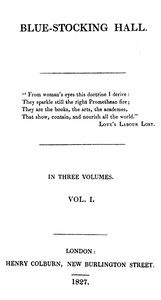
The catalog record for Blue-Stocking Hall, (Vol. 1 of 3) — Inside the Classic provides practical reading context through 63,861 words, 4 hr 38 min estimated reading time, and 7 detected text sections.
The text analysis averages about 30.8 words per sentence, while the detected sections provide another way to judge how the source is divided.
Project Gutenberg metadata also associates the work with “Epistolary fiction,” connecting these edition facts with the source record’s subject description.
Explore this collection
These alternatives are selected using recorded categories and estimated reading time.
About 278 minutes
Fantasy Juvenile Worlds
63,743 recorded words. 0 minutes difference from this book's estimate.
View Gutenberg source #41816About 285 minutes
Fantasy Juvenile Worlds
65,432 recorded words. 7 minutes difference from this book's estimate.
View Gutenberg source #41415About 286 minutes
Fantasy Juvenile Worlds
65,695 recorded words. 8 minutes difference from this book's estimate.
View Gutenberg source #41529Search stored excerpts and compare books → Choose by your preferences →
Choices use stored catalog measurements. Estimates vary with reading speed. A shared category is a catalog label, not a claim that two books have the same argument or literary quality.
Search reads excerpt text stored with this catalog and links to its associated Gutenberg record. The connection is stored in the site database; this tool does not recheck that every excerpt is word-for-word identical to that external record. Excerpt search does not cover every chapter and does not verify historical publication dates.
Catalog snapshot checked: 2026-09-26. Coverage: 93 public books, 93 available source excerpts.
Calculated from edition completeness, EPUB availability, text structure and catalogue metadata. Not a user rating.
Total of 100 points, scaled to a 2.5-5.0 range. Editions with an empty description or a missing EPUB file are not scored.
Public-domain source text
The source text is kept in the dedicated reader, separate from this catalogue record and its commentary.
The preface of Blue-Stocking Hall announces a conversion narrative: the author once held prejudices against ladies stigmatized as Bas Bleus, but now wishes readers to adopt a fairer belief. This editorial note examines how the catalog subjects—epistolary fiction, women's conduct, and women's education—align with the excerpts. The letters are selected from a four-year correspondence, and the preface frames them as an expiatory tribute, akin to a criminal's last speech, intended to prevent others from falling into similar errors. The opening letter, from Charles Falkland to Arthur Howard, begins at Dover, awaiting a steam-packet to Calais, setting a travelogue tone that frames the ensuing observations.
The novel is presented as a collection of letters spanning four years, a form that allows for varied perspectives and a gradual unfolding of character. The first letter, from Charles Falkland to Arthur Howard, establishes a parallel between the two correspondents: both are awaiting transport, one to France, the other to Ireland. This symmetry suggests that the letters will serve as a bridge between distant experiences. The preface explicitly states that the letters sufficiently explain their own story, implying a self-contained narrative that does not require external commentary. However, the excerpts show that the letters are not merely reportorial; they contain embedded narratives, such as Mr. Otway's recital of a tragic family history, which is relayed within Falkland's letter. This layered storytelling creates a sense of depth, as the reader receives secondhand accounts of events that have shaped the characters. The epistolary form also allows for shifts in tone: Falkland notes that he is growing serious and fears losing his spirits, indicating that the letters are crafted to evoke emotional responses. The catalog subject of epistolary fiction is thus borne out, but the excerpts reveal a sophisticated use of the form to intertwine multiple voices and temporalities.
The catalog subjects highlight women's conduct and education, and the excerpts offer glimpses of how these themes are treated. In a passage describing a humble cottage, the narrator praises inborn elegance and argues that true refinement derives from within, not from outward trappings. This sentiment is applied to the women of Blue-Stocking Hall, who are described as pattern specimens of human nature, embodying dignity and simplicity. The text explicitly contrasts vulgarity, which brings the machinery of life in all its ugliness, with the soul that presides at the banquet. This suggests that the novel advocates for an inner cultivation that transcends material circumstances. The preface indicates that the author once held prejudices against learned women, but the excerpts show a household where women are educated and yet remain domestic. For instance, Mr. Otway sends plants to Fanny, a little pupil, and Emily extracts a promise from the narrator to learn plant names. These details imply that women's education is integrated into daily life, not separated from it. However, the excerpts do not reveal the full scope of the curriculum or the women's intellectual pursuits, so the reader must infer that education is presented as a natural, harmonious part of their character.
The setting of Blue-Stocking Hall is evoked through specific, sensory details that reinforce the novel's themes. The preface places the action in a country house, but the excerpts expand this to include a sacred promontory, a winding path, and a botanic garden sheltered by a hawthorn hedge bursting into a sheet of fragrant blossoms. These natural settings are not mere backdrops; they are spaces where moral and emotional revelations occur. Mr. Otway's tragic tale is delivered on a promontory, and the shift from seriousness to playfulness is marked by a physical turn from that spot. The botanic garden, where plants are gathered for Fanny, symbolizes the cultivation of knowledge and virtue. The narrator's promise to learn plant names for Emily suggests that the natural world is a site of education and connection. The catalog subjects do not explicitly mention setting, but the excerpts show that place is integral to the novel's exploration of conduct and education. The contrast between the machinery of life and the soul that presides at the banquet is mirrored in the contrast between the vulgar world and the refined enclave of Blue-Stocking Hall. The setting thus functions as a physical manifestation of the ideals the novel espouses.
Readers approaching Blue-Stocking Hall should attend to the interplay between the letters' surface narrative and the embedded stories that reveal character. The preface's claim of conversion invites scrutiny: does the novel consistently uphold the fairer belief it promises, or do tensions remain? The excerpts suggest a world where refinement is innate, but the full correspondence may complicate this ideal. Pay attention to how the setting—gardens, promontories, and domestic interiors—reflects the inner lives of the characters, and note how the epistolary form allows for multiple, sometimes conflicting, voices to shape the reader's understanding.
Often, after closing the letters from Blue-Stocking Hall, I find myself musing on how quiet conviction shapes a life—not loud claims, but small, daily choices. That same gentle thread runs through I've Been Thinking; or, the Secret of Success — Themes and Context, where success feels less like a destination and more like a soft, persistent turning toward what matters. One book reminds me of the other, almost like noticing the same light in two different windows.
Answer a few questions and save a private reflection on this device.