About 286 minutes
Tales from the X-bar Horse Camp: The Blue-Roan "Outlaw" and Other Stories — Inside the Classic
Fantasy Juvenile Worlds
65,695 recorded words. 1 minutes difference from this book's estimate.
View Gutenberg source #41529
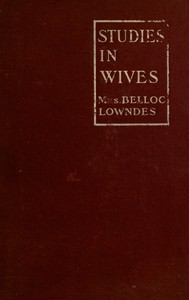
This digital edition of Studies in Wives — A Closer Reading is described by source-level measurements including 65,432 words, 4 hr 45 min estimated reading time, and 6 detected text sections.
The text analysis averages about 21.6 words per sentence, while the detected sections provide another way to judge how the source is divided.
Project Gutenberg metadata also associates the work with “Short stories, English,” connecting these edition facts with the source record’s subject description.
Explore this collection
These alternatives are selected using recorded categories and estimated reading time.
About 286 minutes
Fantasy Juvenile Worlds
65,695 recorded words. 1 minutes difference from this book's estimate.
View Gutenberg source #41529About 278 minutes
Fantasy Juvenile Worlds
63,861 recorded words. 7 minutes difference from this book's estimate.
View Gutenberg source #40974About 278 minutes
Fantasy Juvenile Worlds
63,743 recorded words. 7 minutes difference from this book's estimate.
View Gutenberg source #41816Search stored excerpts and compare books → Choose by your preferences →
Choices use stored catalog measurements. Estimates vary with reading speed. A shared category is a catalog label, not a claim that two books have the same argument or literary quality.
Search reads excerpt text stored with this catalog and links to its associated Gutenberg record. The connection is stored in the site database; this tool does not recheck that every excerpt is word-for-word identical to that external record. Excerpt search does not cover every chapter and does not verify historical publication dates.
Catalog snapshot checked: 2026-09-26. Coverage: 93 public books, 93 available source excerpts.
Calculated from edition completeness, EPUB availability, text structure and catalogue metadata. Not a user rating.
Total of 100 points, scaled to a 2.5-5.0 range. Editions with an empty description or a missing EPUB file are not scored.
Public-domain source text
The source text is kept in the dedicated reader, separate from this catalogue record and its commentary.
In the opening of "Althea's Opportunity," the first story in this collection, a discreet cough from a footman jolts Althea Scrope from her thoughts. She has been standing at a curtainless window—her husband dislikes curtains—gazing at a snowy St. James's Park. The scene establishes a pattern visible across these six stories: a wife's interior life is interrupted by the demands of household management, and her environment reflects her husband's preferences, not her own. Lowndes builds tension through small, telling details: the butler Dockett, who was once her husband's valet, still regards Althea as an interloper. The narrative voice stays close to the wife's perspective, registering her discomfort without overt commentary.
Across the excerpts, husbands exert control through seemingly minor preferences. Perceval Scrope dislikes curtains, so his wife's drawing-room has none. Dering, in a later story, reflects with satisfaction that his wife Louise has fulfilled his early ideal of a mate who can "clean a grate, to cook a dinner, and to discuss Ibsen." The phrasing reveals a husband who prizes versatility but frames it as a checklist of his own design. Lowndes does not label these men as villains; instead, she lets their casual assumptions speak. Dering is proud of his "good sense" and believes he and Louise have "triumphantly defied convention," yet he also notes that lately she has been "listless and tired, utterly unlike herself." The gap between his self-congratulation and her unspoken fatigue is a recurring structural device.
Lowndes builds drama from what is not said. Althea Scrope knows that Dockett regards her as an interloper, but she does not confront him. She has never asked her husband why he calls the butler "Trip"—"she had not liked to ask; her husband often spoke a language strange to her." That single sentence encapsulates a marriage of asymmetrical knowledge. In the Dering story, the husband remembers that his mother was insane, but the thought is a brief shudder, quickly suppressed. The narrative does not explore its implications for his marriage or his own mind. These withheld reactions create a texture of restraint: the wives, and sometimes the husbands, feel more than they articulate, and the reader must read between the lines of polite conversation and interior monologue.
Lowndes uses place to reflect emotional states. Althea's window overlooks a frozen lake and snow-covered park—a "charming outlook" that nonetheless oppresses her. The quietude of the scene makes her feel cold despite having been warm from walking. Dering, after a tense interview with a lawyer, walks through a Thames-side garden and then into Westminster Abbey, where the "spirit of quietude" soothes him only momentarily before he feels indignation at the monuments around him. These settings are not mere backdrops; they are active elements that amplify or contrast with the characters' inner turmoil. The Abbey, meant to inspire reverence, instead provokes in Dering a "half voluntarily comic indignation," revealing his self-absorption even in a sacred space.
These stories reward attention to the spaces between dialogue and the weight of unremarked gestures. Lowndes rarely tells the reader what to think about a marriage; she presents the evidence and lets the contradictions accumulate. A wife's silence, a husband's complacency, a room without curtains—each detail contributes to a portrait of intimacy as a field of small, persistent tensions. Readers may find themselves rereading passages to catch the flicker of irony or the moment a character almost reveals something true.
There’s something about those quiet, restless wives in Lowndes’s portraits—caught between the lives they chose and the selves they set aside—that reminds me of reading Tales from the X-bar Horse Camp: The Blue-Roan "Outlaw" and Other Stories — Inside the Classic, where even the wildest spirit learns the ache of the corral. Both books hold that same flicker of longing, held privately, without anyone calling it by name.
A brief reflection can help important ideas stay with you longer.