About 313 minutes
The Honey-Pot — Inside the Classic
Historical Social Novels
71,910 recorded words. 6 minutes difference from this book's estimate.
View Gutenberg source #42531
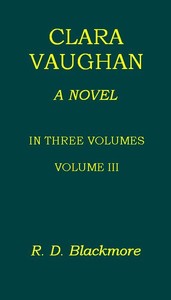
The source record for Clara Vaughan, Volume 3 (of 3) — Background and Themes measures this digital text at 73,196 words, 5 hr 19 min estimated reading time, and 9 detected text sections.
The text analysis averages about 20.1 words per sentence, while the detected sections provide another way to judge how the source is divided.
Project Gutenberg metadata also associates the work with “Mystery fiction,” connecting these edition facts with the source record’s subject description.
Explore this collection
These alternatives are selected using recorded categories and estimated reading time.
About 313 minutes
Historical Social Novels
71,910 recorded words. 6 minutes difference from this book's estimate.
View Gutenberg source #42531About 310 minutes
Historical Social Novels
71,259 recorded words. 9 minutes difference from this book's estimate.
View Gutenberg source #41021About 302 minutes
Historical Social Novels
69,403 recorded words. 17 minutes difference from this book's estimate.
View Gutenberg source #39432Search stored excerpts and compare books → Choose by your preferences →
Choices use stored catalog measurements. Estimates vary with reading speed. A shared category is a catalog label, not a claim that two books have the same argument or literary quality.
Search reads excerpt text stored with this catalog and links to its associated Gutenberg record. The connection is stored in the site database; this tool does not recheck that every excerpt is word-for-word identical to that external record. Excerpt search does not cover every chapter and does not verify historical publication dates.
Catalog snapshot checked: 2026-09-26. Coverage: 93 public books, 93 available source excerpts.
Calculated from edition completeness, EPUB availability, text structure and catalogue metadata. Not a user rating.
Total of 100 points, scaled to a 2.5-5.0 range. Editions with an empty description or a missing EPUB file are not scored.
Public-domain source text
The source text is kept in the dedicated reader, separate from this catalogue record and its commentary.
The third volume of Clara Vaughan opens with Edgar Vaughan's first-person account of his tempestuous love for Fiordalisa, a narrative that immediately establishes a heightened, almost operatic register. Blackmore contrasts this with Clara's more measured voice in the framing chapters, creating a deliberate shift in pace and emotional temperature. The excerpt from Edgar's story uses extravagant metaphors—'zenith star of ecstasy,' 'nadir gulf of agony'—and a breathless syntax that mimics obsessive passion. This stylistic departure from Clara's earlier narration signals a key structural choice: the novel embeds a secondary narrator whose voice is markedly different, offering readers a layered perspective on the central mystery.
The volume contains at least two distinct narrative voices. Clara's chapters are direct and procedural, focused on gathering evidence and managing practical matters. In contrast, Edgar Vaughan's embedded story (Chapter X) adopts a florid, emotionally charged style. He describes his love as 'a thunder flood' and uses elaborate natural imagery—'cicale waking,' 'muffro leaping,' 'love-birds whispering'—to evoke a Southern, passionate setting. This voice is self-consciously literary, with asides like 'how weak our English words are.' The contrast is sharp: Clara's language is restrained, even when describing distress; Edgar's is expansive and theatrical. Blackmore uses this juxtaposition to differentiate characters and to modulate the novel's pace, slowing the detective plot for an intense emotional interlude.
Alongside the emotional passages, Blackmore includes meticulous procedural scenes that ground the narrative in practical investigation. Clara's interactions with the bailiffs Balaam and Balak are rendered with precise dialogue and attention to legal forms: she has them sign a deposition, reclaims a cheque, and issues a new one payable three days later. The narrative notes her maxim—'Never trust, beyond the length of a cork, any man who is slave to the bottle'—which reveals a hard-won pragmatism. These scenes move at a deliberate, almost legalistic pace, contrasting with the rapid emotional swings of Edgar's story. The alternation between these modes creates a rhythm that keeps the reader engaged without allowing either tone to dominate.
Several motifs recur across the excerpts, linking the different narrative strands. The 'charm' of chalcedony that Isola wears around her neck is a physical object that carries symbolic weight—it was her brother Conrad's, and Clara ceases to examine it upon learning that. This moment echoes earlier instances where objects trigger memory or suspicion. Another recurring element is the theme of 'feigning' and hidden emotion: Edgar describes Fiordalisa 'feigning, I say, in cold blood, to reckon her noble lovers,' while Clara later notes that Conrad has made 'some wonderful mistake.' These repeated references to deception and misunderstanding suggest that the novel's mystery hinges on misread signs and concealed identities. The motifs of the 'tower under siege' and the 'third stroke of paralysis' also appear, reinforcing the sense of impending crisis.
Readers approaching this final volume should attend to the shifts in narrative voice and pacing, as Blackmore uses them to control the release of information and emotional intensity. The embedded story of Edgar Vaughan offers a key to understanding the central relationships, but its heightened style should be weighed against Clara's more reliable perspective. The procedural details—depositions, cheques, surveillance—are not mere filler but integral to the resolution of the mystery. Pay particular attention to physical objects like the chalcedony charm, as they may carry clues that the characters themselves overlook.
All these years shelving mysteries, I’ve noticed how Clara Vaughan finds her truth through patient, aching memory, much like a certain quiet snowfall’s slow accumulation. Each page seems to settle upon the last, soft and inevitable, until the whole landscape of a family's silence lies revealed. There is a tender weight in such uncovering. A kinship, I think, with The Snowball — Background and Themes, where secrets drift down just as gently, and just as deeply.
Use these questions to collect your thoughts before moving on.