About 313 minutes
The Honey-Pot — Inside the Classic
Historical Social Novels
71,910 recorded words. 3 minutes difference from this book's estimate.
View Gutenberg source #42531
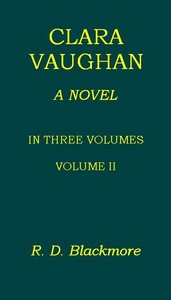
For Clara Vaughan, Volume 2 (of 3) — Reading Notes, the stored edition analysis reports 71,259 words, 5 hr 10 min estimated reading time, and 9 detected text sections.
The text analysis averages about 17.5 words per sentence, while the detected sections provide another way to judge how the source is divided.
Project Gutenberg metadata also associates the work with “Mystery fiction,” connecting these edition facts with the source record’s subject description.
Explore this collection
These alternatives are selected using recorded categories and estimated reading time.
About 313 minutes
Historical Social Novels
71,910 recorded words. 3 minutes difference from this book's estimate.
View Gutenberg source #42531About 302 minutes
Historical Social Novels
69,403 recorded words. 8 minutes difference from this book's estimate.
View Gutenberg source #39432About 319 minutes
Historical Social Novels
73,196 recorded words. 9 minutes difference from this book's estimate.
View Gutenberg source #41022Search stored excerpts and compare books → Choose by your preferences →
Choices use stored catalog measurements. Estimates vary with reading speed. A shared category is a catalog label, not a claim that two books have the same argument or literary quality.
Search reads excerpt text stored with this catalog and links to its associated Gutenberg record. The connection is stored in the site database; this tool does not recheck that every excerpt is word-for-word identical to that external record. Excerpt search does not cover every chapter and does not verify historical publication dates.
Catalog snapshot checked: 2026-09-26. Coverage: 93 public books, 93 available source excerpts.
Calculated from edition completeness, EPUB availability, text structure and catalogue metadata. Not a user rating.
Total of 100 points, scaled to a 2.5-5.0 range. Editions with an empty description or a missing EPUB file are not scored.
Public-domain source text
The source text is kept in the dedicated reader, separate from this catalogue record and its commentary.
Volume 2 of Clara Vaughan opens with Clara alone in her room by firelight, trying to understand her attraction to Isola. The scene establishes a pattern of introspection and movement: Clara's thoughts shift from self-examination to the eight-year-old murder, then to remorse for having softened. The arrival of Inspector Cutting, whose heavy step contrasts with his catlike stealth, introduces a structural rhythm of interruption and revelation. Blackmore uses physical details—firelight, a loud step, a quiet pony—to mark transitions between Clara's internal struggles and external action.
Clara's first scene in this volume is lit only by firelight, a recurring image that signals private reflection. She cannot work, and her thoughts move from Isola to the murder, then to guilt for having been distracted by “laughing children, and snug firesides, with dickybirds, and Sandy the squirrel.” The firelight creates a confined, introspective space that is repeatedly broken by external forces: Cutting's loud step, the news of her uncle's illness, and later the vast, unfamiliar rooms of Vaughan House. This pattern of quiet contemplation shattered by intrusion drives the narrative forward.
Inspector Cutting is a figure of controlled noise. He “could walk when needful like a cat” but deliberately makes “double noise when not on business.” This detail reveals his theatricality and manipulation. He tells Clara only part of what he has done, and his abrupt compliment—“Miss Valence, I know pluck when I see it”—is a calculated probe. Cutting's movements and speech are tools of investigation, and Clara's responses to him show her growing wariness. The contrast between his heavy tread and Farmer Huxtable's lighter step underscores the difference between genuine country solidity and Cutting's performative authority.
Clara's uncle is described in a striking image: found “bolt upright in his study chair, and fully dressed, with two pistols, loaded and cocked, on the table, no sign of life in his face or pulse, his body stiff yet limp, like a sand-bag tightly stuffed.” This tableau of paralysis and readiness recurs throughout the volume. The uncle's condition—catalepsy giving way to paralysis—mirrors Clara's own emotional state: frozen between vengeance and gentleness. The detail of the pistols, cocked but unused, echoes the unresolved murder and the threat of violence that hangs over the household.
When Clara returns to Vaughan House, the rooms appear “vast” and “endless” after the smaller spaces of Tossil's Barton and Mrs. Shelfer's. She hurries to her mother's former rooms, where a lamp and fire are lit, and finds Matilda Jenkins, a servant who has risen from scullery-maid to under-housemaid. The contrast between the familiar western wing and the alienated rest of the house reflects Clara's displacement. Blackmore uses spatial details—the length of passages, the arrangement of parlour and bedroom—to map Clara's emotional geography: she is both insider and outsider, measuring every step as if relearning her own past.
Readers attentive to structure will notice how Blackmore alternates between Clara's solitary musings and scenes of confrontation or revelation. The firelight, the detective's footsteps, the frozen uncle, and the shifting rooms are not mere decoration but structural markers of Clara's psychological journey. This volume rewards careful attention to recurring images and the movement between intimate and public spaces, as each transition deepens the mystery of the father's murder and Clara's own divided loyalties.
There’s a particular ache in watching Clara chase certainty through all that fog and firelight—how the truth keeps slipping just past her lantern. I remember that same restlessness lingering after A Lost Cause — A Reader’s Guide, that quiet weight of questions no one answers. Both books leave you sitting with the hush after the last page, remembering your own half-lit corridors. A Lost Cause — A Reader’s Guide stayed with me like that.
Capture what you thought, learned, and would like to remember.