About 90 minutes
Jewels of Gwahlur — Reading Companion
Fantasy Juvenile Worlds
20,591 recorded words. 3 minutes difference from this book's estimate.
View Gutenberg source #42236
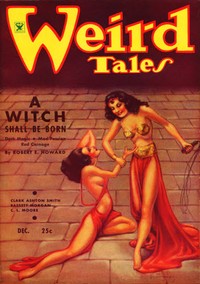
This digital edition of A Witch Shall Be Born — Themes and Context is described by source-level measurements including 19,973 words, 1 hr 27 min estimated reading time, and 2 detected text sections.
The text analysis averages about 16.6 words per sentence, while the detected sections provide another way to judge how the source is divided.
Project Gutenberg metadata also associates the work with “Fantasy fiction, American,” connecting these edition facts with the source record’s subject description.
Explore this collection
These alternatives are selected using recorded categories and estimated reading time.
About 90 minutes
Fantasy Juvenile Worlds
20,591 recorded words. 3 minutes difference from this book's estimate.
View Gutenberg source #42236About 68 minutes
Fantasy Juvenile Worlds
15,569 recorded words. 19 minutes difference from this book's estimate.
View Gutenberg source #42188About 68 minutes
Fantasy Juvenile Worlds
15,583 recorded words. 19 minutes difference from this book's estimate.
View Gutenberg source #42196Search stored excerpts and compare books → Choose by your preferences →
Choices use stored catalog measurements. Estimates vary with reading speed. A shared category is a catalog label, not a claim that two books have the same argument or literary quality.
Search reads excerpt text stored with this catalog and links to its associated Gutenberg record. The connection is stored in the site database; this tool does not recheck that every excerpt is word-for-word identical to that external record. Excerpt search does not cover every chapter and does not verify historical publication dates.
Catalog snapshot checked: 2026-09-26. Coverage: 93 public books, 93 available source excerpts.
Calculated from edition completeness, EPUB availability, text structure and catalogue metadata. Not a user rating.
Total of 100 points, scaled to a 2.5-5.0 range. Editions with an empty description or a missing EPUB file are not scored.
Public-domain source text
The source text is kept in the dedicated reader, separate from this catalogue record and its commentary.
The opening chapter, 'The Blood-Red Crescent,' establishes a doppelgänger plot: queen Taramis awakens to find a disembodied head that speaks with her own face, claiming to be her twin sister. The apparition's voice is described as 'honeyed venom,' and the candles flare up 'like flaming serpents'—a sensory detail that signals supernatural intervention. The catalog subjects list 'Fantasy fiction, American' and 'Conan (Fictitious character) -- Fiction,' but the excerpts devote more space to the twin sisters' confrontation and the political intrigue of Khauran than to Conan himself. He does not appear until the fourth chapter, 'Wolves of the Desert,' where he is already a lieutenant to the raider Olgerd Vladislav, bearing scars from a crucifixion mentioned in passing.
The story hinges on a physical double: Taramis and Salome are identical in 'every contour of feature and limb,' yet Salome's face reflects 'the opposite of every characteristic the countenance of the queen denoted.' The text emphasizes this contrast through dialogue—Salome's speech is 'sweet, poisonously mocking,' while Taramis is bewildered and fearful. The usurper's cruelty is suggested by her plan to 'cut off her head in the public square,' but the excerpts do not reveal whether this is carried out. The mute beggar who overhears this plot recognizes the queen lives, hinting at a resistance thread that the incomplete text leaves unresolved.
Chapter 4 shifts to a tented camp where Olgerd Vladislav, a former Zaporoskan hetman turned desert chief, debates strategy with Conan. Olgerd's attire is described in lavish detail—'white silk,' 'pearls,' 'green silk turban'—contrasting with Conan's 'black mesh-mail' and 'worn leather scabbard.' Their exchange reveals a pragmatic alliance: Olgerd boasts of his leadership, while Conan counters that he has 'earned everything' with 'blood and sweat.' The dialogue touches on recruitment, raiding, and ambitions of empire, grounding the fantasy in the logistics of desert warfare. The catalog's 'Conan' subject is accurate, but the excerpts show him as a lieutenant, not the primary protagonist of the opening chapters.
Several details recur across the excerpts. Scars mark Conan's palms and body, linking to his crucifixion; the beggar's hands are 'brown, sinewy' and 'quivering strongly,' suggesting hidden strength. Severed heads appear twice: the apparition's head in a disk of light, and a literal severed head held by the beggar. Mirror imagery pervades the twin scene—Taramis feels she is looking into a 'mirror which subtly altered her reflection.' These motifs reinforce themes of identity and violence, but the excerpts do not explain the beggar's role or the head's significance. The catalog's 'Fantasy fiction, American' label fits, but the story's structure—shifting from palace horror to desert adventure—is more varied than the subject headings suggest.
Readers should note that the excerpts cover only the first four chapters and the Project Gutenberg boilerplate; the full story may resolve the twin plot and Conan's rise. The catalog subjects emphasize Conan, but the opening chapters focus on Taramis and Salome, making the queen's fate a central question. Pay attention to how Howard uses sensory details—light, voice, texture—to distinguish the sisters, and how the desert setting contrasts with the palace's claustrophobic magic.
That Conan story left me thinking about how a twin can wear your face and still be a stranger, and how betrayal sometimes feels like losing your own name. It reminded me of something quieter but just as sharp in Mrs. Maxon Protests — Inside the Classic, where identity gets twisted in a more domestic, aching way. That ache lingers, believe me.
Create a short personal record of your experience with this book.